Madmaheshwar Trek Difficulty: How Hard Is This Trek, Really?
Ask anyone who's done the Madmaheshwar trek and you'll get a similar answer: it isn't technical, but it isn't easy either. There are no ropes, no glacier crossings, no exposed ridge walks — just a long, steady climb through forest and meadow that tests stamina more than skill. Most first-time trekkers rate it moderate to moderately difficult: harder than a weekend hill walk, but well within reach of anyone who trains a little beforehand.
The honest answer depends on which part of the trek you mean — the walk to Gaundhar, or the final stretch to the temple — since each has a different character. This guide breaks the difficulty down stage by stage, so you know exactly what you're signing up for. For the full walking route itself, see the Madmaheshwar Trek Guide
Quick verdict: Madmaheshwar is a moderate Himalayan trek — roughly 16-18 km one-way, gaining close to 1,700 metres in altitude over two days. It's harder than Tungnath or Chandrashila, and comparable in effort to the walk to Kedarnath, minus the crowds and the pony traffic.
Difficulty at a Glance
| Trek Distance | ~16-18 km one-way (Ransi to the temple), spread over 2 days |
| Altitude Gained | From ~1,800 m at Ransi to ~3,500 m at the temple |
| Difficulty Level | Moderate to moderately difficult |
| Trail Type | Forest path, stone steps, open meadow — no technical climbing |
| Fitness Needed | Regular walking fitness; prior hill-walking experience helps |
| Compares To | Harder than Tungnath–Chandrashila; similar effort to Kedarnath |
1. Distance, Duration & the Route Breakdown
The trek starts where the road ends, at Ransi village. From there it's roughly seven kilometres to Gaundhar, the usual first overnight halt, mostly through pine and oak forest on a well-defined trail. The second day covers the harder stretch — around eight to nine kilometres from Gaundhar past Banatoli meadow to the temple, with the gradient noticeably steeper in the final couple of kilometres.
Most itineraries split the walk across two days for exactly this reason: doing all seventeen-odd kilometres and the full altitude gain in a single push is where trekkers tend to struggle, especially without prior acclimatization. Splitting it also leaves room for a slower pace on day two, which matters more than most people expect once you're above 3,000 metres. If you're short on time, some fit trekkers do complete it in a long single day — but that's a call worth making on the trail itself, not in advance. How you're feeling at Gaundhar tells you more than any itinerary can.
2. Altitude & Acclimatization
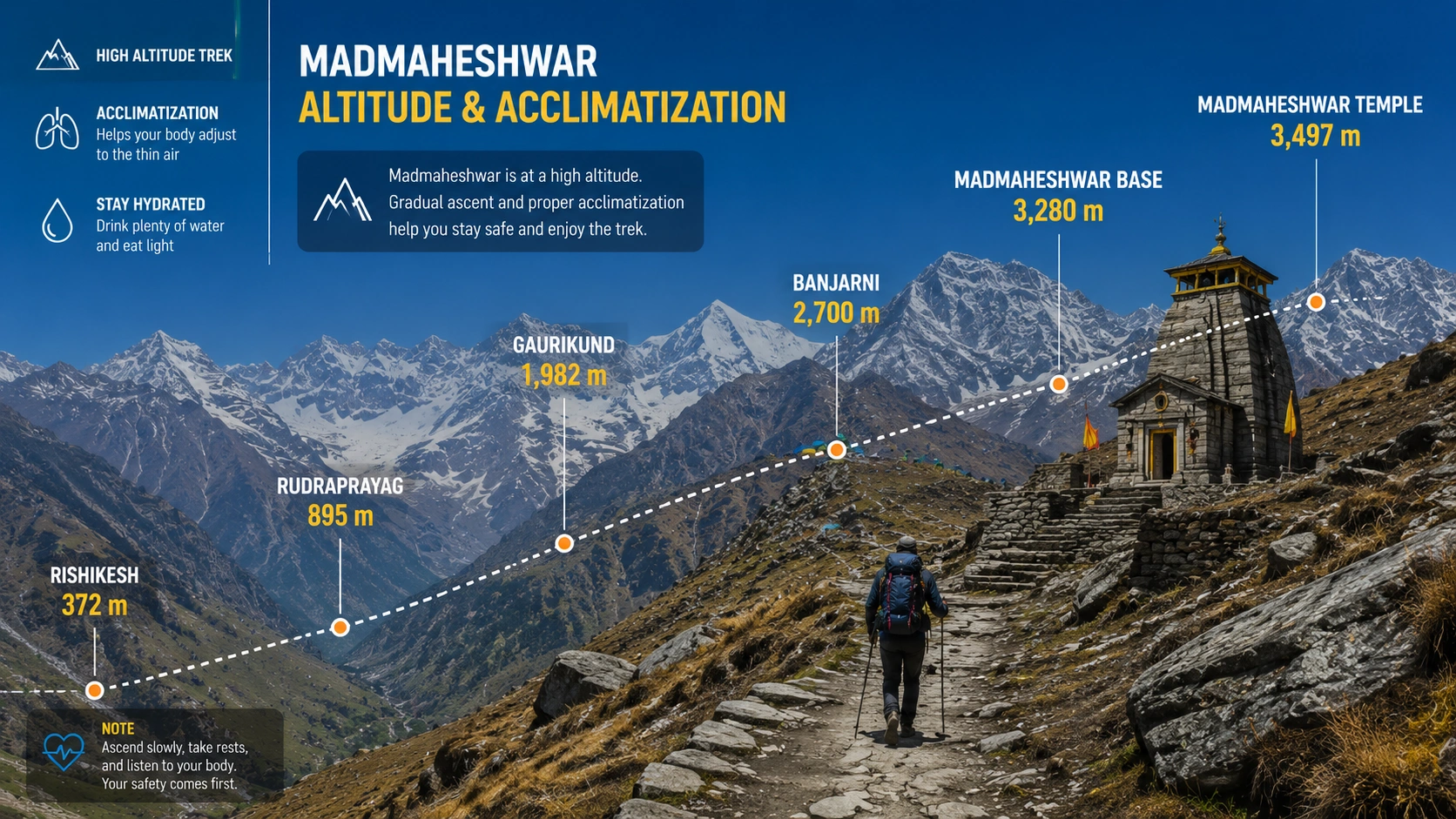
Altitude is the part of the difficulty that catches people off guard, because it has nothing to do with fitness. Ransi sits at a comfortable elevation, but by the time you reach the temple you've climbed to somewhere around 3,500 metres, and that gain happens over just two days of walking — fast enough that mild symptoms like headache, breathlessness, or a loss of appetite aren't unusual, even for people who trek regularly at lower altitudes. None of this is unique to Madmaheshwar; it's simply how the Himalaya works above 3,000 metres.
What helps is pacing rather than pushing — a slow, steady rhythm covers ground just as fast as walking hard and resting often, but with far less strain on the body. Staying well hydrated, eating enough even when appetite drops, and treating the overnight halt at Gaundhar as a genuine acclimatization stop, rather than just a place to sleep, all make a real difference on day two.
3. Trail Terrain — What Actually Makes It Hard
There's nothing technical about the Madmaheshwar trail — no rock climbing, no ladders, no exposed sections requiring a harness — but the terrain still adds up. The first stretch to Gaundhar is a fairly gentle forest path, shaded and pleasant, with a gradual incline that most people find manageable without much trouble.
It's the second day that changes character. Past Banatoli, the trail opens into meadow and the gradient steepens, particularly on the final approach to the temple, where loose stone and a narrower path demand more attention with every step. In the monsoon months the same stretch turns slippery underfoot, and a misplaced step matters more than it would on flat ground. None of this requires technical skill, but it does require sustained effort — legs that are used to walking uphill for hours, not just a single steep flight. Trekking poles help more here than on almost any other Panch Kedar trail, mainly because they take pressure off the knees on the way down, which is where most people actually feel the trek the next day.
4. Weather-Related Difficulty
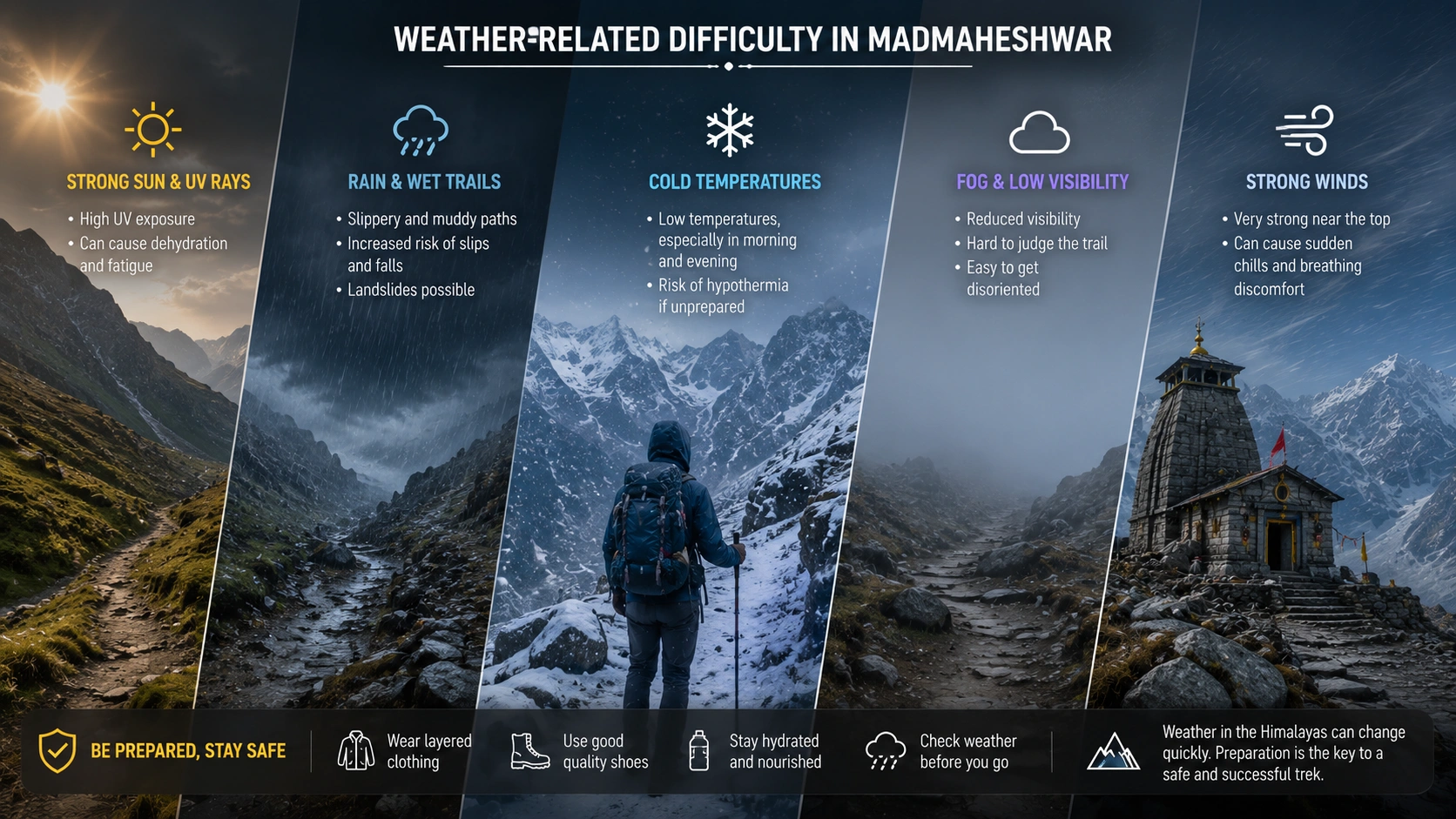
The season you choose changes the difficulty as much as the trail itself does. Late May and June bring the most stable trekking conditions — clear paths, manageable temperatures, and good visibility, though also the biggest crowds around the temple's opening. July and August, the monsoon months, add a real layer of difficulty: the trail turns muddy and slippery, stream crossings can swell after heavy rain, and visibility drops on cloudy days. September and October are generally considered the easiest window overall — the monsoon has passed, the trail has dried out, and the views are at their clearest, even if the mornings turn noticeably colder. Trekking outside the temple's open season isn't an option at all; the route above Gaundhar is usually snowbound through the winter months, which is a difficulty of an entirely different kind.
5. How Madmaheshwar Compares to Other Panch Kedar Treks
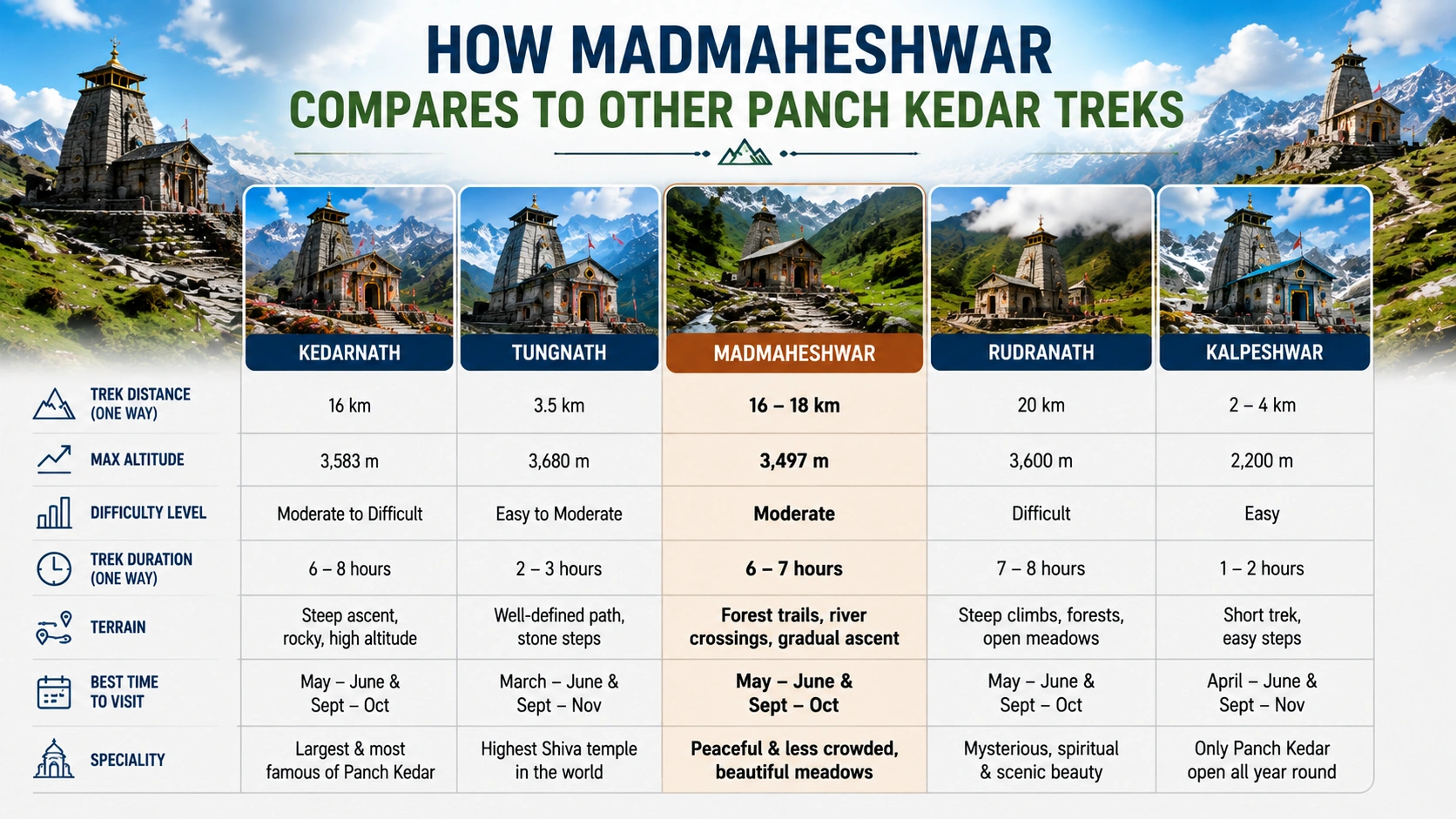
Difficulty is relative, and Madmaheshwar sits in an interesting middle ground among the Panch Kedar treks. It's noticeably harder than Tungnath and Chandrashila, which can be done as a half-day outing. It's broadly comparable in physical effort to the trek to Kedarnath, though Kedarnath has the advantage of pony, palki, and helicopter options that Madmaheshwar simply doesn't offer — here, walking is the only way in. Compared to Rudranath, most trekkers rate the two similarly tough, though Rudranath's trail is generally considered slightly more remote and less maintained.
| Trek | Distance (one-way) | Difficulty |
|---|---|---|
| Tungnath – Chandrashila | ~4–5 km | Easy |
| Madmaheshwar | ~16-18 km | Moderate |
| Kedarnath | ~16 km | Moderate (pony/palki available) |
| Rudranath | ~20 km | Moderate–Difficult |
6. Who Can Attempt This Trek
You don't need mountaineering experience for Madmaheshwar, but you do need a reasonable base level of fitness. As a rough guide:
- Comfortable if: you can walk 8–10 km on hilly terrain without major difficulty, have done at least one moderate trek or long hike before, and don't have any condition that altitude could seriously aggravate.
- Manageable with preparation if: you're generally active but new to trekking — a few weeks of stair climbing, brisk walking, or light cardio beforehand makes a real difference.
- Worth reconsidering if: you have a heart or lung condition, or very limited walking stamina — the altitude and sustained climb are unforgiving of both.
Children and older trekkers can and do complete this Yatra, but it needs a slower pace and more built-in rest — that's covered in more detail in our guide on Madmaheshwar with family.
7. Tips to Make the Trek Easier
- Break the walk into two days rather than rushing it in one, even if you're fit enough to attempt a single push.
- Start early each day — mornings are cooler and the trail is far less crowded near the temple.
- Use trekking poles, especially for the descent, where knee strain does most of the damage.
- Hire a local porter or mule for your main bag if you're carrying more than a light daypack; it changes the trek completely.
- Pace yourself uphill with short, steady steps rather than bursts of speed and long rests — it's easier on the body and usually faster overall.
- Carry enough water and simple snacks; dehydration and low energy make the terrain feel far harder than it actually is.
- Don't skip the overnight halt at Gaundhar even if you feel strong — it genuinely helps with acclimatization for day two.
None of this makes Madmaheshwar an extreme trek — thousands of ordinary trekkers and pilgrims complete it every season. What it does require is realistic preparation: knowing the distance, respecting the altitude, and pacing the walk instead of rushing it. For the exact route and what to pack, see the Madmaheshwar Trek Guide, and for where to stay at each stage, the hotels & stay guide.
Ready to plan your trek? Browse the available Madmaheshwar trek packages, which include experienced local guides who pace the route for exactly this kind of trail.
Frequently Asked Questions
Common questions about how hard the Madmaheshwar trek actually is.
1. How difficult is the Madmaheshwar trek?
Madmaheshwar is a moderate to moderately difficult trek. It involves no technical climbing, but a sustained uphill walk of roughly 17 km with significant altitude gain makes it more demanding than a casual day hike.
2. What is the altitude of the Madmaheshwar temple?
The Madmaheshwar temple sits at approximately 3,500 metres, reached from a base around 1,800 metres at Ransi, over roughly two days of trekking.
3. How many kilometres is the Madmaheshwar trek?
The trek is roughly 17 km one-way from Ransi to the temple, usually covered over two days with an overnight halt at Gaundhar.
4. Do I need a guide for the Madmaheshwar trek?
The trail is well-defined and doesn't require technical guiding, but a local guide or an organized trek makes navigation, pacing, and stay arrangements considerably easier, especially for first-time trekkers.
5. Is the Madmaheshwar trek harder than Kedarnath?
The physical effort is broadly similar, but Kedarnath offers pony, palki, and helicopter options that Madmaheshwar does not, so on Madmaheshwar, walking is the only way in, which makes it feel comparatively harder for many trekkers.
6. What fitness level is needed for the Madmaheshwar trek?
A reasonable base fitness helps — being able to walk 8 to 10 km on hilly terrain without major difficulty is a good benchmark. Prior trekking experience isn't mandatory, but a few weeks of preparation makes a noticeable difference.